


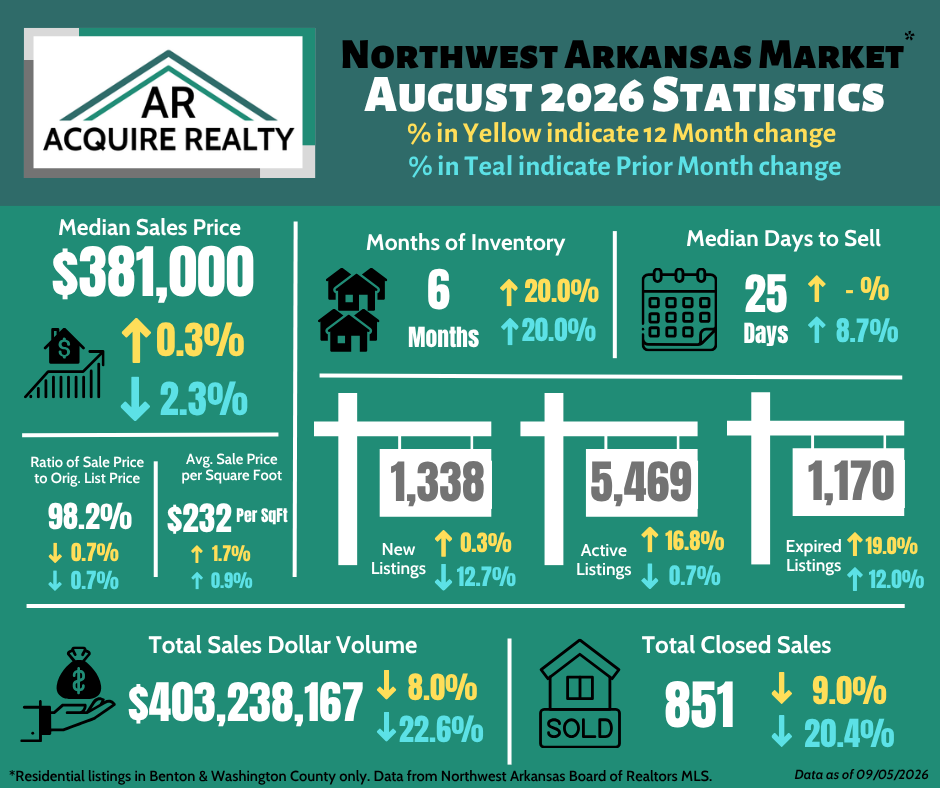
 NWA Market Statistics Update for August
 While still a solid month for residential real estate sales in NWA, we have entered the slower months of the year as we approach Fall.
So far 2026 overall, sellers lost a little bit of the clear advantage on the market that they have enjoyed since 2020. Months of inventory (MOI) is a statistic that gives a broad perspective of how much seller activity there is versus buyer activity there is in a market. At its most basic, MOI is how many months it would take to sell all active listings if no new listings came on the market but the rate buyers are closing on homes stayed the same. This statistic increases when (a) sellers enter the market at a higher pace than buyers or (b) buyers leave the market faster than sellers. Both signs of a shifting market. In general, when thinking of MOI, think smaller numbers indicate a trend toward sellers’ markets and larger numbers indicates a trend toward buyer’s markets.
For the last 3 years, the peak activity months (March-July), MOI has been 3 or 4…a clear sellers’ market. This year MOI for NWA in March to July was either 5 or 6. Meaning, sellers didn’t have quite the same leverage as the last few years. That said, MOI below 8 is still a sellers’ market. If we are heading toward 12 MOI, we would be clearly entering a buyers’ market.
There are still signs that NWA is a healthy market. The pricing metrics (median sales price, price per sqft, and original list price to sales price) saw very minimal changes. Signs of stability. These statistics would be seeing larger changes if the market was shifting noticeably. Additionally, the ratio of original list price to sale price has been 98% or higher this entire year. Meaning sellers are only having to come down very slightly to find a buyer.
One other thing that was worth pointing out is the significant decrease in total sales, both by dollar and by count. Both metrics had more than a 20% decrease from July. This was the largest percent decrease in 1-month change since January 2025. Outside of the month of January (which is consistently the least productive month of the year), this is the largest percentage decrease between consecutive months in 8 years; both for total sales by dollar and by count (Sept 2018, -31.8% for both metrics). It’s also worth noting, any time in the past 8 years when there has been at least a 20% decrease in sales for a single month change (by dollars or count), the following month saw an average of a 43% increase in percentage change. Meaning, any time there has been a large decrease it was immediately followed by a significant increase. That is, it was a once-off fluctuation rather than a pattern. Thus, if we see a further decrease or little-to-no increase next month, that would be a sign of something different happening this time as compared to the prior 8 years. We shall see.
The final comment about this market update is that the statistic for Median Days to Sell is back, but it comes with an asterisk. We have not been including it in the last 13 months updates, because it was not reporting correctly in the MLS system. Now they have changed the calculation for determining this number. Median days to sell is now being reported as the number of days a listing has not been under contract. Which can be useful to know, but it is only part of the story. The other part of the picture is how long it takes a property to officially close from the first day it hit the market. Our system does not provide this information any more. We think it is misleading to report “median days to sell” in August as 25 days. Most seller will interpret that to mean if they list their house today, it should be sold in 25 days. That’s not correct. It means it’s taking about 25 days to go under contract, and there is no perspective on how many days it then takes to close. My opinion is this stat should be called median “active” days on market, not median days to “sell”. But given this is the data we have available, we will work with it going forward.
If you have any questions about the condition of the market or even specific areas of NWA, reach out, and we’ll see what we can find.